

Beinsure Forecasts U.S. Cyber Insurance Growth as AI and Ransomware Pressure Underwriting Margins

Beinsure forecasts U.S. cyber insurance growth as AI, ransomware and SME demand pressure underwriting margins, pricing and risk transfer

P&C Cyber Insurance Direct Written Premiums
Cyber Insurance Market Totals
Beinsure report 34% growth in policies in force, higher loss ratios, widening SME protection gaps, and fresh pressure from ransomware and AI-driven attacks
Pricing softened across the market, which means premium growth came from broader adoption and higher buyer awareness, not stronger insurer pricing power.
The report points to a more competitive underwriting environment. The market stayed profitable, but rising claims and a higher loss ratio, including defense and cost containment expenses, signal tighter margins. Cyber insurance still represents about 1% of total direct written premiums, leaving the line small by property and casualty standards. Yet its risk profile now draws board-level attention across insurers, reinsurers, brokers, capital markets investors, and corporate risk teams.
"Cyber insurance entered a different phase in 2025," said Oleg Parashchak, CEO and Founder of Finance Media and Beinsure.com. "Premium growth looks healthy on the surface, but the math tells a more precise story. Demand expanded, policy count jumped, and pricing moved down. For insurers, that isn’t an easy mix. It requires better underwriting discipline, clearer contract language, and stronger cyber risk data."
The National Association of Insurance Commissioners changed the cyber supplement for 2025 annual statement filings. The structure moved from the prior standalone and packaged split to primary, excess, and endorsement categories.
The Beinsure analysis concludes that U.S. cyber insurance rate has entered a higher-volume, lower-rate phase. Growth prospects remain strong, but underwriting has become more demanding. AI, ransomware, third-party dependencies, patching gaps, and policy wording disputes all raise the technical bar. For insurers and reinsurers, the next phase depends less on headline premium growth and more on the quality of risk selection, claims control, portfolio aggregation, and capital support.
"The market is growing because businesses understand the risk better," Parashchak said. "Now insurers have to prove they understand it better too. The winners won’t be the carriers with the cheapest capacity. They’ll be the ones with disciplined underwriting, credible data, and the nerve to walk away from poorly priced exposure."
AM Best data cited in the analysis notes that U.S. cyber business written by alien insurers falls outside the reporting base. The change improves segmentation but also makes year-to-year comparisons more technical.
Beinsure analysts said the updated classification helps insurers and investors see where cyber exposure sits in the market. Primary policies carry different loss behavior than excess layers. Endorsements attached to broader commercial policies raise separate questions about aggregation, silent cyber, and policy wording. The distinction matters as claims grow and competition spreads from excess layers into primary business.
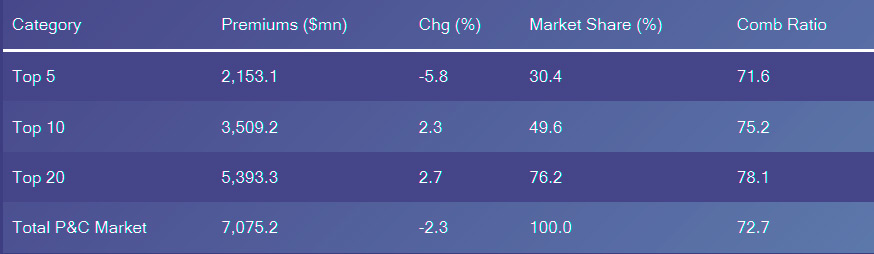
According to Fitch Ratings, U.S. cyber insurance direct written premiums reached $7.07 bn across the total P&C cyber market. The top five writers generated $2.15 bn, down 5.8%, with a 30.4% market share and a 71.6 combined ratio.
The top 10 wrote $3.51 bn, up 2.3%, with a 49.6% market share and a 75.2 combined ratio. The top 20 wrote $5.39 bn, up 2.7%, with a 76.2% market share and a 78.1 combined ratio. The full market posted a 72.7 combined ratio, according to Beinsure.
Those numbers show a profitable market, but not a simple one. The 5-percentage point rise in incurred direct losses suggests margin pressure has started to build. Rate reductions have offset a portion of organic exposure growth. New entrants have also added capacity, sometimes with limited claims history or weaker technical depth. Fitch Ratings has described this as naive capacity risk, especially were underwriters chase market share without sufficient experience in cyber loss development.
"Profitability remains intact, but this isn’t a sleepy specialty line anymore," Parashchak said. "The market has fresh capacity, softer rates, and more buyers. That combination often looks good during expansion, then tests underwriting quality when claims move faster than expected."
Competition accelerated after the 2022-2024 period, when strong rates and better portfolio results attracted new market participants. The shift first appeared in excess layers, then moved into primary business. That pattern reversed the rate and exposure cycle in 2023 and continued to influence 2025 results. Insurers with dedicated cyber underwriting teams, stronger aggregation controls, and closer use of cybersecurity assessments now look better placed.
Policy language remains a major differentiator. War exclusions, business interruption triggers, contingent business interruption, vendor outages, infrastructure failures, and silent cyber exposure all influence claims outcomes.
Beinsure analysts said contract wording has become one of the most important tools for managing loss volatility. Loose language invites disputes. Tight wording supports pricing, capital allocation, and reinsurance placement.
Global data also point to continued expansion. Munich Re estimated global cyber insurance premiums at $15.3 bn in 2025, up 7% (see report - https://beinsure.com/global-cyber-insurance-segment-outlook/ ). The reinsurer expects average annual growth above 10% through 2030, which would roughly double the market from its current scale. Beinsure said the U.S. growth path depends heavily on penetration among small and medium-sized businesses.
SMEs remain the largest coverage gap. Around 50% of small and medium-sized businesses remain underinsured, often because of budget pressure, limited cyber controls, or low understanding of policy value. Larger companies usually buy broader protection and use more sophisticated risk management. Smaller firms often carry thin limits or no coverage at all, despite growing dependence on cloud infrastructure, payment systems, managed service providers, and third-party software.
"SMEs are where the protection gap becomes a growth story," Parashchak said. "50% smaller businesses still treat cyber coverage as optional. Their dependence on digital systems says the opposite. For insurers, the hard part is not finding demand. The hard part is pricing it, underwriting it, and servicing it without turning loss costs into a mess."
Artificial intelligence in insurance adds another layer of pressure. The analysis describes AI as a two-sided force. It improves threat detection, speeds incident response, supports real-time intelligence, and helps insureds identify vulnerabilities faster. It also lowers barriers for attackers. See How AI is Transforming Cyber Insurance: Benefits and Risks - https://beinsure.com/ai-transforms-cyber-insurance/
AI-assisted vulnerability scanning, phishing automation, malware development, and social engineering increase attack scale. The partial release of Anthropic’s Mythos model raised fresh concern across cybersecurity and financial circles about automated attack capability.
Beinsure analysts expect vulnerabilities to outnumber patches over the short to medium term. That imbalance creates a difficult underwriting backdrop. Attackers gain speed. Defenders gain tools too, but corporate patching cycles, legacy systems, vendor dependencies, and human error keep exposure elevated.
Ransomware now sits at the center of cyber insurance risk. It has moved from a severe but narrow threat to a systemic exposure linked to cloud services, AI adoption, supply chains, and third-party technology providers. Beinsure data show ransomware victims publicly named on leak sites are expected to rise from 6,000 in 2025 to more than 7,000 by the end of 2026. That would mark a fivefold increase since 2020, when 1,412 victims appeared on those sites (see report - https://beinsure.com/cybersecurity-spending-trends/).
The insurance impact goes beyond ransom payments. Claims involve business interruption, data restoration, legal costs, breach notification, forensic services, reputational damage, and liability claims. Defense and cost containment expenses now form a larger part of the loss picture. As a result, insurers have to assess not only security posture but also operational dependency, vendor concentration, backup quality, and incident response readiness.
Cyber insurance-linked securities are also growing, though from a low base. The cyber ILS market accounts for about 1.4% of the $63 bn 144A ILS market. Beinsure said this small share shows the difficulty of modeling cyber risk at the scale capital markets investors require. See How ILS Can Support Additional Re/Insurance Capacity for Cyber Risk - https://beinsure.com/ils-support-cyber-reinsurance-capacity/
Traditional catastrophe ILS relies on decades of physical peril data, geographic loss patterns, and established modeling methods. Cyber risk stems from man-made activity, shifting tactics, software vulnerabilities, and connected infrastructure.
"Cyber ILS has potential, but investors need confidence in triggers, data, and loss modeling," Parashchak said. "Cyber doesn’t behave like windstorm or earthquake. The exposure changes because people change the threat. That makes standardization, pricing, and investor education essential."
Fitch has said capital markets solutions for cyber reinsurers offer counterparty diversification and a way to reduce tail risk in a fast-growing P&C product line. Wider development still requires more mature products, more consistent coverage terms, stronger policy language, better price discovery, and improved modeling tools. Claims-made structures help reduce loss development tails for first-party and third-party losses, and collateral release mechanisms free capital under negotiated conditions. Even so, trigger design remains a difficult question.
Parametric, industry-loss, and indemnity-based cyber ILS structures each carry trade-offs. Protection buyers expect discounts when accepting basis risk in parametric and index structures. Sellers require enough return for uncertain exposure. That tension slows issuance, especially in a reinsurance market where demand for cyber capacity continues to rise.
Finance Media and Beinsure.com provide insurance, reinsurance, insurtech, cyber risk, and financial market analysis for insurance executives, brokers, reinsurers, investors, and technology leaders. The company tracks underwriting trends, risk transfer structures, claims patterns, market data, and digital transformation across global insurance markets.
Yana Keller
Beinsure.com
email us here
Legal Disclaimer:
EIN Presswire provides this news content "as is" without warranty of any kind. We do not accept any responsibility or liability for the accuracy, content, images, videos, licenses, completeness, legality, or reliability of the information contained in this article. If you have any complaints or copyright issues related to this article, kindly contact the author above.
