

Data Exfiltration Market to Surge at 10.12% CAGR, Anticipated to Reach USD 257.34 Billion by 2035
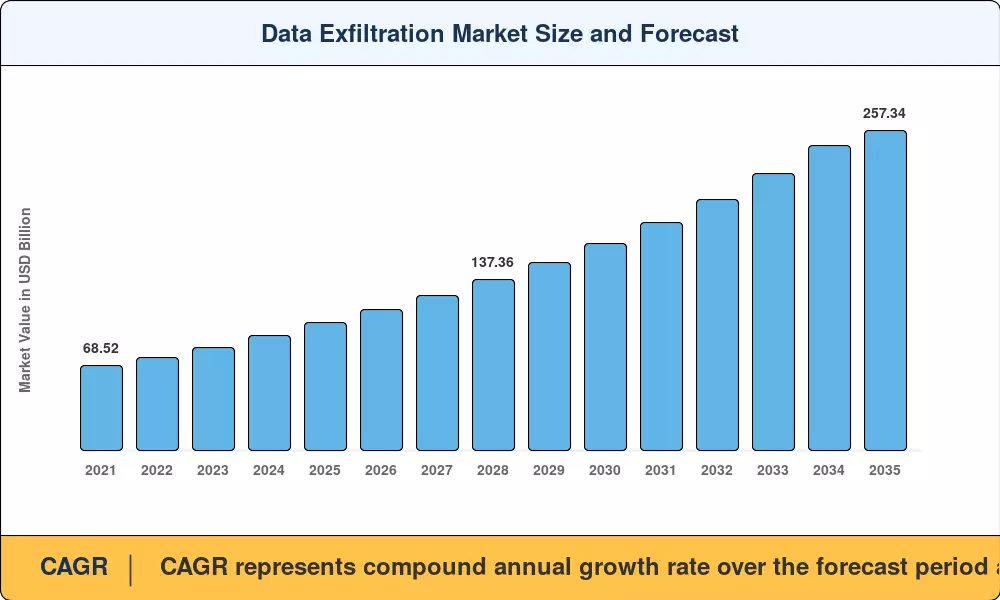
Data Exfiltration Market
Data Exfiltration Market is growing rapidly due to rising cyber threats and demand for advanced data security solutions globally.
Data Exfiltration Market represents the rapidly evolving cybersecurity landscape driven by rising data breach threats and advanced protection needs.”
ONTARIO, NEW YORK, CANADA, June 18, 2026 /EINPresswire.com/ -- Data exfiltration market is experiencing strong and continuous expansion, fueled by the rising complexity of cyber threats and the accelerating dependence of organizations on interconnected digital infrastructures. As cybercriminal activities become more advanced and targeted, enterprises across multiple sectors are increasing investments in advanced security frameworks to protect sensitive information from unauthorized access and theft. — Market Research Future
The Data Exfiltration Market was valued at USD 102.87 billion in 2025 and is projected to grow from USD 113.28 billion in 2026 to USD 257.34 billion by 2035, registering a CAGR of 10.12% during the forecast period. This strong growth reflects the rising frequency of data breaches, the expansion of cloud-based ecosystems, and the growing adoption of technologies such as data loss prevention (DLP), endpoint detection and response (EDR), and AI-driven threat intelligence solutions.
As digital transformation accelerates across industries, the volume of sensitive corporate and personal data being generated, stored, and transmitted has increased significantly, making data protection a critical priority for organizations worldwide. The market includes a wide range of solutions and services designed to detect, prevent, and respond to unauthorized data transfers across cloud environments, on-premises systems, hybrid infrastructures, and mobile networks.
Industries such as banking, financial services, insurance (BFSI), healthcare, government, and IT & telecommunications are leading adopters due to strict regulatory compliance requirements and high-value data assets. Overall, the increasing reliance on digital platforms, combined with stringent data privacy regulations and growing cybersecurity awareness, continues to strengthen the long-term growth outlook of the global data exfiltration market.
Leading Industry Participants
The data exfiltration market is characterized by the presence of several globally recognized cybersecurity vendors, each competing to offer comprehensive, AI-driven threat detection and data protection platforms. These key players are continuously investing in research and development, strategic partnerships, and mergers and acquisitions to strengthen their market positions and expand their geographic footprints. The leading participants shaping the competitive landscape of the data exfiltration market include:
• Palo Alto Networks
• CrowdStrike Holdings
• Broadcom Inc. (Symantec)
• IBM Corporation
• Cisco Systems Inc.
• Fortinet Inc.
• McAfee Enterprise (Trellix)
• Trend Micro Incorporated
• Check Point Software Technologies
• Forcepoint LLC
• Varonis Systems
• Digital Guardian (Fortra)
• Zscaler Inc.
• SentinelOne
• Tenable Holdings
These organizations are leveraging machine learning, behavioral analytics, and zero-trust architecture frameworks to deliver next-generation solutions that can proactively detect anomalous data movement patterns, flag insider threats, and respond to external intrusion attempts in real time. Strategic collaborations with cloud service providers such as AWS, Microsoft Azure, and Google Cloud are also enabling vendors to deliver scalable, cloud-native data exfiltration prevention capabilities to a growing base of enterprise customers.
Download Sample Pages of Research Overview - https://www.marketresearchfuture.com/sample_request/28105
Key Growth Factors
Several powerful macro and industry-specific forces are catalyzing the expansion of the data exfiltration market over the forecast period. The exponential increase in the volume and variety of enterprise data, combined with the rapid adoption of cloud computing, remote work models, and Internet of Things (IoT) devices, has significantly expanded the attack surface for cybercriminals, making data exfiltration a more prevalent and complex threat than ever before. Simultaneously, the rise of sophisticated, nation-state-sponsored advanced persistent threats (APTs) and organized cybercriminal groups employing multi-vector attack strategies is compelling organizations to invest heavily in advanced threat intelligence and proactive data protection capabilities.
Regulatory compliance mandates across sectors including GDPR in Europe, CCPA in California, HIPAA in healthcare, and various national cybersecurity frameworks are compelling organizations to invest in robust data security infrastructure or face severe financial penalties and reputational damage. The growing frequency of high-profile data breaches across Fortune 500 companies, government agencies, and critical infrastructure operators has further heightened boardroom awareness of cybersecurity risk, accelerating the deployment of integrated data protection platforms. The proliferation of artificial intelligence and machine learning technologies in cybersecurity solutions has also emerged as a major growth driver, enabling real-time anomaly detection, predictive threat modelling, and automated incident response at a scale previously unattainable with traditional rule-based systems.
Emerging Growth Opportunities
The data exfiltration market presents a rich landscape of emerging opportunities for vendors, investors, and technology innovators. The accelerating adoption of zero-trust security architecture across enterprise environments is creating substantial demand for advanced identity and access management (IAM), micro-segmentation, and continuous authentication solutions that collectively minimize the risk of unauthorized data movement. The rapid expansion of cloud-native applications and microservices environments presents a significant opportunity for vendors offering specialized cloud workload protection platforms (CWPP) and cloud security posture management (CSPM) solutions tailored to prevent data exfiltration in dynamic, containerized environments.
The growing adoption of generative AI and large language models (LLMs) within enterprise workflows introduces novel data exfiltration risks, including the unintentional disclosure of sensitive data through AI prompts, creating a nascent but highly promising market for AI-specific data governance and protection tools. In emerging economies across Asia-Pacific, Latin America, and the Middle East, increasing digitalization of financial services, government operations, and healthcare systems is driving fresh demand for affordable, scalable data security solutions, representing a largely untapped growth frontier. Furthermore, the integration of data exfiltration prevention capabilities into broader extended detection and response (XDR) and Security Operations Centre (SOC)-as-a-Service platforms is creating bundled upsell opportunities for established cybersecurity vendors.
Key Market Barriers & Challenges
Despite its impressive growth outlook, the data exfiltration market faces a number of significant barriers and structural challenges that could temper expansion in certain segments and geographies. One of the most pressing challenges is the global shortage of skilled cybersecurity professionals, which limits the ability of many organizations — particularly small and medium-sized enterprises — to effectively deploy, manage, and optimize sophisticated data protection solutions. The complexity and high cost of deploying enterprise-grade DLP and threat detection platforms remain significant adoption barriers, especially for resource-constrained SMEs in developing markets where cybersecurity budgets are limited.
The rapidly evolving nature of cyber threats poses an ongoing challenge for vendors and security teams alike, as attackers continuously develop new techniques — including living-off-the-land attacks, steganographic data hiding, and encrypted exfiltration channels — that can evade conventional detection mechanisms. Privacy concerns and data sovereignty regulations in regions such as the European Union also create compliance complexities for multinational organizations deploying cloud-based security solutions that may involve cross-border data transfers. Additionally, the fragmentation of the vendor landscape and the proliferation of point solutions create integration challenges for enterprises seeking to build cohesive, platform-based security architectures, often leading to alert fatigue, operational inefficiencies, and security coverage gaps.
Segment-wise Market Breakdown
The data exfiltration market is segmented across multiple dimensions, including solution type, deployment mode, organisation size, industry vertical, and geography. Each segment presents distinct growth dynamics and investment opportunities. The primary market segments include:
By Solution:
• Data Loss Prevention (DLP)
• Intrusion Detection & Prevention Systems (IDPS)
• Security Information and Event Management (SIEM)
• User and Entity Behaviour Analytics (UEBA)
• Endpoint Detection and Response (EDR)
• Cloud Access Security Broker (CASB)
By Deployment Mode:
• On-Premise
• Cloud-Based
• Hybrid
By Organization Size:
• Large Enterprises
• Small and Medium Enterprises (SMEs)
By Industry Vertical:
• Banking, Financial Services and Insurance (BFSI)
• Healthcare, Government & Defense
• IT & Telecommunications
• Retail & E-commerce
• Energy & Utilities, Manufacturing
By Threat Type:
• Insider Threats
• External Threats (APTs, Ransomware)
• Accidental Data Loss
By Geography:
• North America
• Europe
• Asia-Pacific
• Latin America
• Middle East & Africa
Among solution types, the Data Loss Prevention (DLP) segment commands the largest market share, owing to widespread enterprise adoption across regulated industries. Cloud-based deployment models are gaining momentum as organizations migrate workloads to multi-cloud environments, necessitating advanced cloud-native security solutions. The BFSI and healthcare verticals collectively account for a significant portion of total market revenue, driven by stringent regulatory requirements such as GDPR, HIPAA, and PCI-DSS.
Explore the In-Depth Report Overview - https://www.marketresearchfuture.com/reports/data-exfiltration-market-28105
Geographical Market Insights
Geographically, the data exfiltration market exhibits distinct regional dynamics, with North America firmly established as the dominant regional market, accounting for the largest share of global revenue. The United States leads the regional market, underpinned by the presence of the world's largest concentration of cybersecurity vendors, a highly mature enterprise IT ecosystem, and some of the world's most stringent regulatory frameworks, including the Cybersecurity Maturity Model Certification (CMMC) for defense contractors and the California Consumer Privacy Act (CCPA). Europe represents the second-largest regional market, with demand strongly driven by GDPR compliance requirements, growing government investment in national cybersecurity capabilities, and rising awareness of state-sponsored cyber espionage targeting critical infrastructure sectors.
The Asia-Pacific region is projected to register the highest compound annual growth rate during the forecast period, fueled by rapid digital transformation across India, China, Japan, South Korea, and Southeast Asian economies, combined with rising incidences of cyber espionage, financial fraud, and intellectual property theft targeting the region's booming technology and manufacturing sectors. Latin America and the Middle East & Africa are smaller but increasingly important growth markets, where rising investment in digital banking, e-government initiatives, and critical infrastructure modernization is creating fresh demand for advanced cybersecurity solutions. National cybersecurity strategies launched by governments in Saudi Arabia, the UAE, Brazil, and South Africa are expected to serve as key catalysts for regional market development over the coming decade.
Frequently Asked Questions (FAQs)
Q1. How does the data exfiltration market differentiate between intentional and accidental data loss in its product categories?
Solutions are categorized by detection methodology—intent-based tools analyze behavioral patterns and access anomalies, while policy-based tools enforce rules regardless of intent. Most enterprise DLP platforms combine both approaches
Q2. What role does DNS tunneling play in modern data exfiltration market threat vectors?
DNS tunneling encodes stolen data within DNS queries to bypass traditional firewalls, accounting for an estimated 20% of sophisticated exfiltration attempts. Specialized DNS monitoring tools are increasingly bundled into broader security platforms.
Q3. How are cyber insurance requirements shaping procurement in the data exfiltration market?
Underwriters now mandate specific controls—encrypted transfer logging, privileged access monitoring—as coverage prerequisites. Organizations lacking these controls face premium increases of 30–50% or outright denial.
Q4. What total cost of ownership should enterprises expect when deploying data exfiltration market solutions at scale?
Enterprise-grade deployments typically cost USD 15–35 per endpoint annually for SaaS-delivered DLP, with on-premises solutions running 2–3x higher due to infrastructure and staffing requirements
Q5. How does the data exfiltration market address exfiltration through generative AI tools like chatbots?
Vendors are deploying AI-aware content inspection engines that detect sensitive data pasted into LLM interfaces. Real-time prompt scanning and API-level controls are the primary enforcement mechanisms.
➤➤ Market Research Future's Regional Market Analysis:
Self-Checkout In Retail Market-
https://www.marketresearchfuture.com/reports/self-checkout-in-retail-market-11034
Digital Content Market-
https://www.marketresearchfuture.com/reports/digital-content-market-11516
Smart Infrastructure Market-
https://www.marketresearchfuture.com/reports/smart-infrastructure-market-11664
5G Smart Farming Market-
https://www.marketresearchfuture.com/reports/5g-smart-farming-market-11695
Hosting Infrastructure Services Market-
https://www.marketresearchfuture.com/reports/hosting-infrastructure-services-market-11701
Metaverse In Real Estate Market-
https://www.marketresearchfuture.com/reports/metaverse-in-real-estate-market-11703
5G System Integration Market-
https://www.marketresearchfuture.com/reports/5g-system-integration-market-11744
Face Swiping Payment Market-
https://www.marketresearchfuture.com/reports/face-swiping-payment-market-11800
Container Security Market-
https://www.marketresearchfuture.com/reports/container-security-market-11906
Tracking As A Service Market-
https://www.marketresearchfuture.com/reports/tracking-as-a-service-market-11930
Sagar Kadam
Market Research Future
+ +1 628-258-0071
email us here
Visit us on social media:
LinkedIn
Facebook
X
Legal Disclaimer:
EIN Presswire provides this news content "as is" without warranty of any kind. We do not accept any responsibility or liability for the accuracy, content, images, videos, licenses, completeness, legality, or reliability of the information contained in this article. If you have any complaints or copyright issues related to this article, kindly contact the author above.
